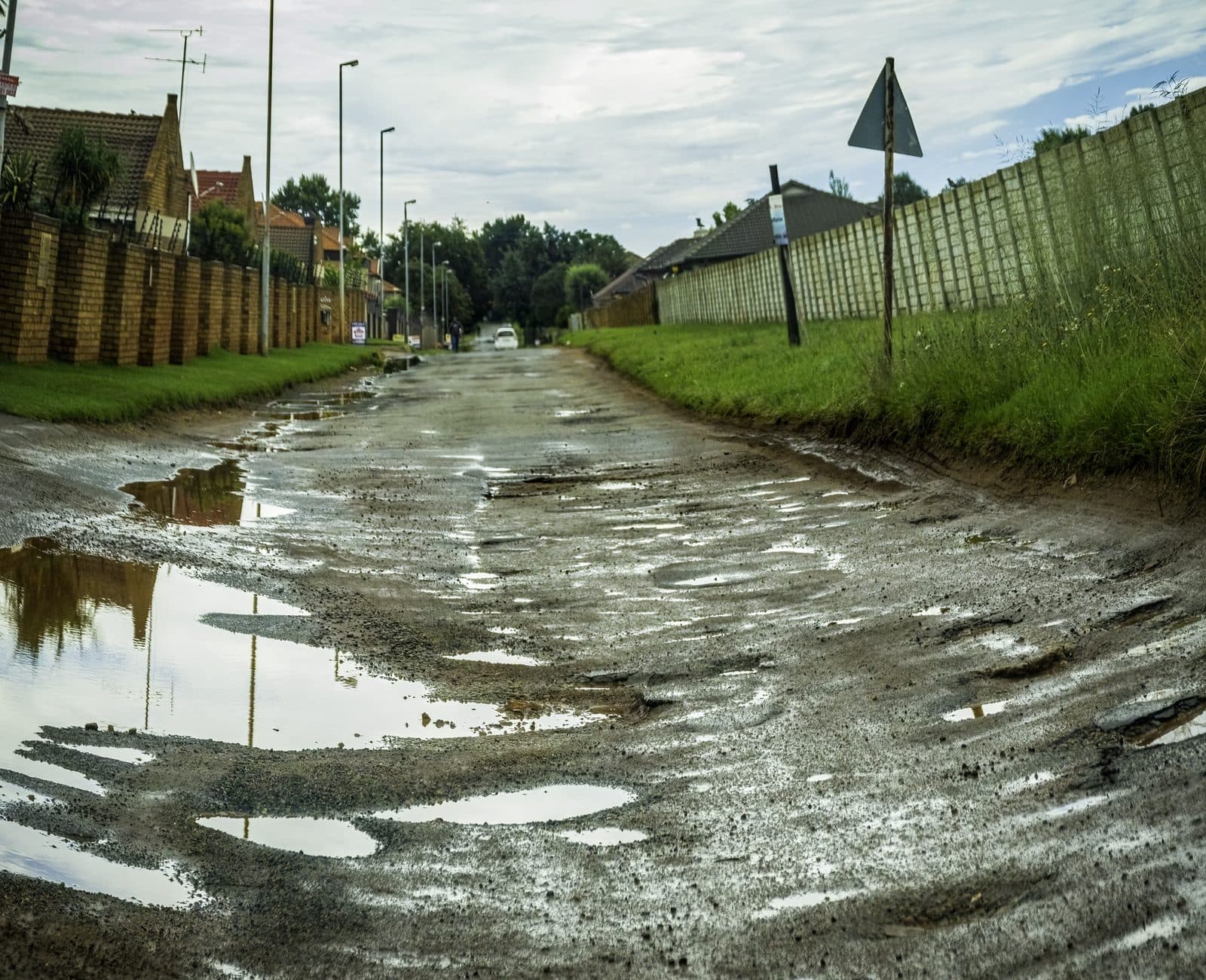
In Johannesburg, a commute can feel like a negotiation with the road. Drivers weave, brake late, and guess which cavity will do the least damage. Ahead of local government elections on 4 November 2026, that daily obstacle course has become political as well as practical.
Mail & Guardian reporting in mid-September framed potholes as one of the most visible measures of how residents experience the city. Political analyst Dirk Kotzé put it plainly: a pothole isn’t only a pavement failure. It can symbolise problematic management of a local authority. Unlike abstract debates about growth strategy, a crater is something you meet with your tyres — often at night, often without warning, sometimes with a repair bill attached.
One motorist’s account in the same coverage captured the cost in ordinary numbers. Two separate hits in 2026 left nearly R4,000 in tyre and related damage, plus a car sitting at home without a roadworthy tyre. ABS and traction warnings lit up after the first incident. The second burst a rear tyre. That’s not a theoretical “infrastructure challenge.” That’s a household losing mobility.
The Johannesburg Roads Agency (JRA) puts scale around the frustration. The city’s road network stretches more than 13,500 kilometres. A recent visual condition assessment found about 21% of the network in poor condition and another 8% in very poor condition — almost three in every ten kilometres in the two worst categories. Over two financial years, the JRA reported repairing 130,473 road-surface deterioration defects in 2024/25 and 126,100 in 2025/26, for a combined 256,573. Importantly, the agency stresses those figures are surface-deterioration defects, not a pure pothole count. Patching, it notes, is often an interim measure to keep traffic moving while deeper problems — ageing pavement, heavy vehicles, intense rainfall, and excavations for services — keep working against the surface.
That last point matters for anyone who manages pavement after utilities dig. A trench that isn’t restored carefully becomes a future failure line. Water finds the weak edge. Traffic pumps the fines. The “new” hole opens next to the old repair. Politics can’t fix that pattern without better reinstatement practice and materials that bond and hold.
Private partnership has also become part of Joburg’s response. Discovery Insure’s Pothole Patrol, launched in 2021 with the JRA and Avis, has repaired more than 365,000 potholes in the city — on the order of 75,000 a year, or about 1,500 a week. The insurer cites sharp drops in reported potholes in areas where the patrol operates, and telematics that concentrate defects on busy arterials and collector routes. Residents have filed tens of thousands of reports through the patrol’s app. Whatever you think of campaign photo ops, a sustained repair programme that residents can trigger is a public-safety asset.
Transport engineers interviewed in the coverage draw a useful line between patching a surface and rehabilitating a structure. If water has weakened the layers below, a thin fill alone may not be enough. Drainage, timely crack sealing, and — when needed — full rehabilitation still sit above any single product. But when a defect is still a surface failure, waiting for a perfect capital project while cars keep taking hits isn’t a neutral choice either.
For contractors, estates, and industrial sites that share Joburg’s climate stresses — heat, storms, heavy axle loads — the practical move is to close hazardous holes quickly with materials designed to perform, then schedule deeper work where diagnostics demand it. EZ STREET® Ambient® Asphalt is a ready-to-use, performance-proven repair option for potholes and related pavement repairs. Bags cover smaller jobs; tonnage supports larger programmes. Properly prepared and compacted, it can be placed without on-site mixing or heating, bonds to asphalt and concrete, works in wet conditions, and is instantly traffic-ready. Thermally resilient, stockpileable supply helps crews respond when weather windows are short.
Ambient® won’t settle an election. It won’t erase a multi-billion-rand infrastructure backlog overnight. What it can support is the part voters actually feel between campaign stops: fewer open hazards on the routes they drive tomorrow morning.
Public-safety framing is the right tone here. Potholes injure wallets first and, in worst cases, people. The constructive path is earlier reporting, honest triage between patch and rebuild, utility reinstatements that don’t sow the next failure, and engineered fills that aim to endure under real traffic. Johannesburg’s voters will decide the politics in November. The roads will keep grading every administration the same way — one axle at a time.
Source notes: Mail & Guardian (10–11 Sep 2026; JRA figures = surface-deterioration defects, not pure pothole counts); ezstreetasphalt.com/what-is-ez-street
Cover photo: Axel Bührmann, CC BY 2.0.